

How Smart Industrial Safety Systems Are Improving Workplace Protection and Compliance

Industrial safety is increasingly becoming a systems-management priority, with businesses combining physical protection, digital monitoring and structured compliance processes to reduce workplace risks. Manufacturers such as Intrepid Industries specialise in OSHA-compliant safety products, including self-closing safety gates, toeboards, safety hooks and custom-moulded polyurethane components. These durable protection solutions help refineries, warehouses, construction sites and other industrial facilities address fall hazards, improve workplace safety and support regulatory compliance.
For modern businesses, workplace safety is no longer solely about installing protective equipment or conducting periodic inspections. It increasingly involves connecting engineering controls, operational procedures, asset management and digital technologyinto a coordinated safety management system.
Industrial Internet of Things (IIoT) devices, environmental health and safety (EHS) platforms, mobile inspection applications and predictive analytics are creating new opportunities to identify hazards and improve organisational oversight.
However, technology cannot replace effective physical safeguards. The greatest value comes from combining reliable protection equipment with systems that help organisations maintain, inspect and manage those assets throughout their operational life.
Why Industrial Safety Is Becoming a Business Technology Priority
Industrial facilities operate in environments where equipment, people and processes must interact safely.
Manufacturing plants, distribution centres, refineries and construction sites may contain elevated platforms, moving machinery, hazardous materials and areas where workers are exposed to falling-object risks.
Managing these hazards requires more than a collection of standalone safety measures.
Traditionally, many organisations have relied on paper inspection forms, manual hazard registers and scheduled site audits. Although these methods remain useful, they can make it difficult to identify recurring problems, monitor corrective actions or establish a consistent view of safety performance across multiple locations.
Digital technology offers a more coordinated approach.
Modern EHS platforms can centralise hazard assessments, inspection records, incident reports and compliance documentation. When integrated with operational systems, they can also help organisations identify relationships between equipment condition, maintenance activity and workplace risks.
For business leaders, this creates three important opportunities: improving visibility of safety performance, strengthening accountability for corrective actions and reducing operational disruption associated with unmanaged hazards.
The objective is not simply to digitise existing paperwork. It is to establish a reliable management process that connects identified risks with the actions needed to control them.
The Role of Integrated Safety Management Systems
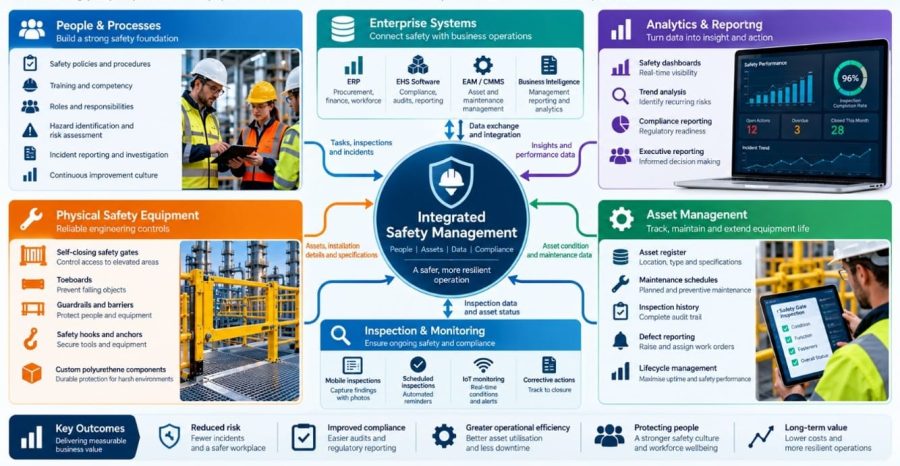
Integrated industrial safety management systems combine physical safeguards, documented procedures, inspection activities and supporting technology.
Each element performs a different function.
Physical safeguards reduce exposure to hazards. Operational procedures establish how work should be performed. Inspection processes identify deterioration or non-compliance, while digital platforms help record findings and coordinate corrective action.
Together, these elements create a more structured approach to workplace protection.
Digital Risk Assessments and Hazard Registers
Digital risk assessment tools allow organisations to record hazards, evaluate their significance and assign responsibility for corrective measures.
For example, an inspection may identify a missing safety gate on an elevated industrial platform.
Rather than recording the finding on paper, an inspector can use a mobile application to capture a photograph, identify the location and create a corrective action.
The issue can then be assigned to the appropriate facilities or maintenance team, with its status tracked until the required protection has been installed and verified.
This creates a documented sequence of identification, action and closure.
EHS Software and Compliance Management
EHS software provides a central platform for managing workplace safety information.
Depending on the product, these systems may support inspections, incident reporting, training records, audits, corrective actions and compliance reporting.
For organisations operating multiple facilities, centralised systems can improve consistency in how safety requirements are monitored.
Management dashboards can also highlight overdue inspections, unresolved hazards and recurring findings.
However, digital records are only useful when supported by clear responsibilities, reliable information and effective follow-up procedures.
Integration With Enterprise Systems
Safety management systems can also be connected to computerised maintenance management systems (CMMS) and enterprise asset management (EAM) platforms.
This is particularly relevant where protective equipment requires routine inspection or maintenance.
A damaged barrier, defective self-closing gate or missing toeboard can be recorded as a safety issue and linked to a maintenance work order.
Integrating these activities reduces the risk of defects being identified but not addressed.
It also creates opportunities to monitor the condition and maintenance history of safety-critical assets.
How Engineering Controls Reduce Workplace Fall Risks
Although digital technology can improve risk management, physical engineering controls remain fundamental to industrial safety.
Engineering controls are designed to remove hazards or reduce exposure without relying entirely on individual behaviour.
For fall protection, these may include guardrails, self-closing safety gates, protected floor openings and other physical barriers.
A properly selected and installed safety gate, for example, helps protect an access opening on an elevated platform while allowing authorised movement through the area.
Self-closing designs are particularly useful because they reduce dependence on workers remembering to close a gate after passing through.
Intrepid Industries manufactures gravity-operated, self-closing industrial safety gates intended for applications such as elevated platforms, ladders and industrial access points.
These products illustrate how relatively straightforward mechanical engineering can address an important operational risk without requiring complex electronics.
Physical safeguards should be selected according to the specific hazard, operating environment and applicable safety requirements.
A barrier suitable for pedestrian access may not be appropriate for a loading platform exposed to material-handling equipment.
Likewise, equipment installed in a chemical processing facility may require different material properties from protection used in a conventional warehouse.
These considerations demonstrate why engineering controls should be assessed as part of the wider facility safety system rather than purchased solely on price.
Toeboards are an important component of industrial fall protection systems, helping prevent tools, equipment and materials from falling from elevated working surfaces. Understanding what is a toe board and how it complements guardrails and self-closing safety gates can help facilities select appropriate engineering controls.
How Smart Technology Supports Industrial Safety
The growing adoption of connected technologies is creating new opportunities for organisations to monitor workplace conditions and manage safety risks.
These technologies do not eliminate hazards, but they can improve the availability and timeliness of information used to make safety decisions.
IoT Sensors and Real-Time Monitoring
Industrial IoT sensors can monitor environmental and equipment conditions, including temperature, vibration, gas concentrations and machine status.
In certain environments, connected systems can generate alerts when predefined thresholds are exceeded.
For example, a refinery may use gas detection systems to identify hazardous concentrations, while a manufacturing facility may monitor machinery conditions to detect abnormal operating patterns.
These capabilities support earlier intervention, provided that sensors are suitable for their intended purpose and alerts are connected to appropriate operational responses.
Digital Inspections and Mobile Safety Applications
Mobile inspection applications allow employees to record findings directly from the workplace.
Photographs, equipment identifiers and location information can be associated with individual inspection records.
This can improve traceability and reduce delays between identifying a defect and assigning corrective action.
For multi-site businesses, digital inspections can also support more consistent reporting across facilities.
Predictive Analytics and Risk Identification
Safety analytics can help organisations identify recurring patterns in incident reports, inspection findings and maintenance records.
For example, repeated defects affecting access gates in a particular area may indicate unsuitable equipment, environmental deterioration or inadequate maintenance arrangements.
Analysing these trends can support more targeted corrective action.
However, predictive models depend on the quality of the information they receive. They should support competent safety management rather than replace professional judgement.
Integrating Safety Equipment With Maintenance and Asset Management
An effective safety programme should establish how protective equipment is inspected, maintained and replaced.
Digital asset management systems can help organisations maintain records of safety-critical equipment, including gates, barriers and other protective components.
Each asset can be assigned a unique identifier, location, inspection schedule and maintenance history.
Where a defect is identified, the system can generate a maintenance request and track the action through to completion.
Importantly, the equipment itself does not need to contain electronic sensors to be included in a digitally managed safety programme.
A conventional mechanical safety gate can still be recorded, inspected and maintained through a CMMS platform.
This distinction is particularly important for businesses modernising established industrial facilities.
Digital transformation does not necessarily require replacing every existing asset with connected equipment. In many cases, improving the systems used to manage those assets can provide significant operational value.
Table 1: Traditional vs Integrated Safety Management
| Capability | Traditional approach | Integrated systems approach |
| Hazard identification | Paper assessments | Digital risk registers |
| Inspections | Manual checklists | Mobile inspection records |
| Compliance monitoring | Periodic reporting | Centralised tracking and dashboards |
| Equipment management | Separate maintenance records | CMMS/EAM integration |
| Incident reporting | Manual documentation | Structured digital workflows |
| Management visibility | Delayed or fragmented | More timely, consolidated information |
An integrated approach can improve the availability of safety information, but the effectiveness of either model ultimately depends on competent personnel, reliable controls and consistent management action.
Cybersecurity and Data Governance in Connected Safety Systems
As organisations connect safety systems with enterprise networks, cybersecurity becomes an additional consideration.
Connected sensors, mobile applications and remote monitoring platforms may process operational information that needs to remain accurate and available.
Unauthorised access, system outages or manipulated data could affect the reliability of safety reporting and operational decisions.
Businesses should therefore consider access controls, secure system integration, software maintenance and backup arrangements when implementing connected safety technology.
Where safety-related systems interact with operational technology, appropriate network segmentation and change management are particularly important.
Data governance also matters.
Organisations need clear ownership of inspection records, consistent asset identifiers and appropriate retention arrangements for compliance documentation.
A digital safety platform is only as dependable as the processes used to maintain its information.
The Business Case for Investing in Industrial Safety Systems
Investment in industrial safety can deliver operational benefits beyond satisfying regulatory requirements.
Effective controls may reduce exposure to hazards, support business continuity and improve the consistency of workplace operations.
Digital systems can also reduce administrative effort and help management teams identify unresolved issues more quickly.
However, benefits should be assessed against implementation, training, maintenance and ongoing system costs.
| Investment area | Potential business benefit | Suggested KPI |
| Engineered fall protection | Reduced exposure to identified hazards | Overdue high-risk corrective actions |
| Digital safety inspections | Improved inspection consistency | Inspection completion rate |
| EHS software | Better compliance visibility | Corrective action closure time |
| Durable safety components | Reduced maintenance burden | Safety asset defect rate |
| Predictive risk analytics | Earlier identification of recurring issues | Repeat hazard frequency |
| CMMS integration | Better maintenance coordination | Overdue safety-critical maintenance |
Businesses should establish baseline performance before implementing improvements and measure outcomes over an appropriate period.
Lagging indicators, such as recorded incidents, should be considered alongside leading indicators, such as inspection completion, hazard resolution and maintenance compliance.
Building a More Proactive Workplace Safety Strategy
Organisations seeking to improve industrial safety should begin with a structured assessment of their existing arrangements.
The first priority is to identify significant hazards and verify that suitable controls are in place.
For elevated platforms, this may involve assessing guardrails, access gates, floor openings and falling-object protection.
The next priority is to establish clear ownership of inspections, maintenance and corrective actions.
Digital tools can then be introduced to improve reporting, coordination and management oversight.
Businesses should avoid treating software implementation as a substitute for effective engineering controls.
A sophisticated dashboard cannot compensate for a missing barrier or a defective access gate.
Similarly, installing high-quality safety equipment without establishing inspection and maintenance responsibilities can leave organisations exposed to preventable risks.
The most effective strategy combines physical protection, competent personnel, documented procedures and appropriate technology.
The Future of Industrial Safety Technology
Industrial safety technology is likely to become increasingly connected as businesses adopt more advanced monitoring and analytics capabilities.
Computer vision systems may help identify certain unsafe conditions, while wearable technologies can support location awareness and environmental monitoring in suitable applications.
Digital twins may enable organisations to model industrial environments and evaluate changes before they are implemented.
Artificial intelligence could also support analysis of inspection records, incident trends and equipment maintenance histories.
These technologies present opportunities, but they introduce practical challenges relating to accuracy, reliability, privacy and implementation cost.
For many businesses, the immediate priority should remain improving established safety processes and integrating existing systems.
Reliable physical safeguards, accurate asset records and effective corrective action management provide the foundation on which more advanced technologies can be introduced.
Frequently Asked Questions
What is an industrial safety management system?
An industrial safety management system is a structured approach to identifying workplace hazards, implementing controls, monitoring performance and maintaining compliance. It may combine physical protection, documented procedures, inspections and digital management tools.
How can technology help reduce workplace fall risks?
Technology can support fall-risk management through digital inspections, hazard tracking, maintenance scheduling and monitoring of relevant workplace conditions. Physical engineering controls, such as guardrails and self-closing safety gates, remain essential where required by the risk assessment and applicable standards.
What is the role of OSHA in industrial fall protection?
The Occupational Safety and Health Administration establishes and enforces workplace safety requirements in the United States. Its regulations include provisions covering walking-working surfaces, guardrails, toeboards and other fall-protection measures. How tall should a toeboard be?Under OSHA’s general industry requirements, toeboards used for falling-object protection must generally be at least 3.5 inches (9 cm) high. Additional requirements apply to clearance, openings and strength, while construction environments may be subject to different provisions.
Do industrial safety gates need electronic monitoring?
No. Many industrial safety gates operate mechanically and do not require electronic connectivity. They can still form part of a digitally managed safety programme through asset registers, inspection records and maintenance workflows.
Can smaller industrial businesses benefit from digital safety systems?
Yes. Smaller organisations can benefit from relatively straightforward tools such as mobile inspection applications, digital hazard registers and maintenance scheduling software. The appropriate investment depends on operational complexity, workplace risks and available resources.
Conclusion
Industrial safety is evolving from a collection of individual protective measures into a more integrated approach to operational risk management.
Physical safeguards remain fundamental, particularly in environments where workers are exposed to elevated platforms, access openings and falling-object hazards.
At the same time, digital inspection tools, EHS platforms, asset management systems and operational analytics are improving how organisations identify, monitor and address workplace risks.
The combination of durable engineering controls and effective digital management provides a practical foundation for safer and more efficient industrial operations.
For business leaders, the priority is not simply to adopt the latest safety technology. It is to establish systems that connect reliable protection equipment with clear accountability, consistent maintenance and useful operational information.
Organisations that take this approach can strengthen compliance management, improve operational visibility and create safer working environments while supporting long-term business resilience.